Authors: Jannik Luhn, Luis Bezzenberger
The most valuable agents will not be just personal. They will be shared.
The dominant frame for AI agents today is the personal assistant: one user, one model, one set of preferences, one calendar to manage. This frame is too narrow.
Most of the friction in human life is not individual, it is collective. Coordination across people, across preferences, across time.
The WhatsApp thread that takes forty messages to pick a restaurant. The club whose treasurer quit and took the institutional knowledge with her. The investment group that has not rebalanced in two years because scheduling the meeting is harder than the decision itself.
Groups are slow because groups are hard, and the cost of that slowness, aggregated across every organization humans participate in, is enormous.
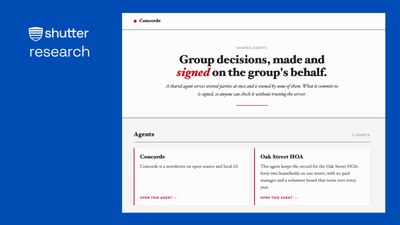
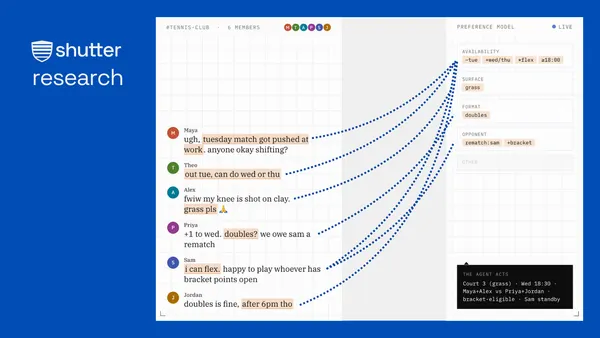
A shared agent is an agent that works for a group rather than a person. Members express their preferences. The group sets the rules. The agent operates continuously, in the open, on behalf of all of them.
A tennis club's shared agent books courts, manages dues, runs the ladder, and handles scheduling conflicts. An investment club's shared agent proposes allocations, executes agreed trades, and produces quarterly updates.
The pattern generalizes far beyond these examples, and it is the more general pattern that makes it worth paying attention to.
We'd like to make the case that shared agents are an emerging space with preference aggregation at its core, that the framing extends to most agent work being done today, and that building it out will require new infrastructure and new research from many teams at once.
Preference Aggregation vs. Voting vs. Delegation
The deepest reason shared agents matter has little to do with productivity. It has to do with how groups decide.
Today, collective decision-making in organizations mostly relies on two mechanisms, both inadequate. Voting, which is slow, low-participation, and coarse. Or delegation to an individual, which centralizes power and burns the delegate out.
These are the tools we have because nothing better existed.
A shared agent introduces a third option. Members continuously express what they care about, in their own language, and the agent aggregates those preferences into a working model of what the group actually wants. It then acts on that model.
No vote per action. No single delegate. The agent represents everyone, all the time, on everything.
This is the cleanest formulation of "decide together" that has been proposed. The agent is not a tool the group uses. The agent is the group, in operational form.
Preferences can enter the system in different ways. The most immediate is context: preferences fed in at every turn, legible and editable. The more interesting long-run path is a fine-tuned model that has internalized a group's values, history, and patterns. Both will exist, alongside hybrid forms that combine fast-changing context with slow-changing weights. Each has different properties around transparency, updateability, and trust, and the design space here is largely unexplored.
What this displaces, over time, is much of the governance machinery groups currently rely on. Board rooms, shareholder meetings, forums, polls, proposals, quorum thresholds, delegate elections. Some of that remains necessary for constitutional moments. Most of it was scaffolding around the absence of a better mechanism, and the better mechanism is now possible.
A Lens on the Broader Agent Space
Once the shared-agent framing is in view, a large fraction of current agent work looks different.
Customer support agents serve thousands of customers and the company simultaneously. Recruiting agents balance the company, the hiring manager, and the candidate. Procurement, property management, supply chain, legal operations, patient navigation, online moderation: all multi-principal, all governed by competing preferences and shared rules.
The personal-agent case is a shared agent with one member. The shared case is the general case, and the infrastructure built for it will subsume the infrastructure built for personal agents, not the other way around.
Early Signals
The pattern is being recognized independently by serious teams.
Paradigm and Tempo recently open-sourced Centaur, a self-hosted multiplayer agent that operates inside Slack on behalf of an entire organization. They have run it internally since January across investing, engineering, recruiting, and operations.
The architecture they describe (shared tools, shared skills, isolated sessions per conversation, secrets the agent never sees) is recognizably the shared-agent pattern, motivated by the same observation: personal-agent infrastructure does not extend to teams.
We expect more announcements of this shape over the next year.
What the Stack Will Require
Four components matter the most.
Preference elicitation and aggregation
Shared agents need a way for many members with varying levels of engagement to express what they want, keep those expressions current, and have them weighted coherently. This is the core problem and the least solved.
Permissioning and verifiable execution
Shared agents need a policy layer between the agent and its tools, with scoped, reversible, audited actions and public logs. Over time, cryptographic guarantees that the agent did what it said it did, removing the need to trust the host. This is the natural home for fully homomorphic encryption, MPC, ZKML, and trusted execution environments, because groups need agents that can use sensitive information without exposing it.
Hosting and deployment
Each group needs an isolated instance that is easy to set up and difficult to misconfigure. This is the boring part of the stack, but the prerequisite for adoption.
Other layers (identity, evaluation, tool design) all change in interesting ways when the assumption shifts from one principal to many. But the three above are the load-bearing ones.
Privacy-preserving coordination
Shared agents need to combine inputs from many people without forcing everyone to reveal everything. The stack will need ways to aggregate preferences, constraints, and sensitive information privately, while still producing outcomes the group can trust.
Agents as the Third Form of Agreement
For centuries, people have coordinated through contracts: flexible, interpretable agreements that rely on courts, trust, and human judgment. Then smart contracts introduced a second model: agreements that execute automatically, with speed and certainty, but only inside narrow, predefined conditions.
Agents introduce a third form.
They can become a new way for people to do business together: faster and more executable than traditional contracts, but more adaptive than smart contracts. An agent can act with the speed of software while still responding to context, preferences, changing information, and the broader world.
It combines the best of both systems: the execution speed of a smart contract with the flexibility and global information access of a human-interpreted agreement.
Are Shared Agents the new DAOs?
DAOs were intended to be autonomous. In practice, they have often functioned as slow committees with treasuries, dependent on a small core team and on the subset of members willing to vote.
Shared agents are the missing piece.
Once members can express their preferences continuously, and an agent can act on those preferences within rules the group has set, the operational work of a DAO no longer has to block on synchronous participation. The participation problem dissolves, not because more people show up, but because showing up stops being the mechanism.
The autonomy that DAOs were always supposed to have becomes architecturally possible for the first time.
Why We are Writing This
Shutter has spent years building governance infrastructure, most recently moving private voting toward fully homomorphic encryption so that groups can decide collectively without revealing how individual members lean.
From that vantage point, shared agents are the most interesting development in the space.
They sit at the intersection of the questions we have been working on: how preferences are collected, how privacy is preserved, how collective action becomes verifiable, and what governance becomes when the unit of action is software acting on behalf of a group.
We do not have a product to announce. We have a thesis that this paradigm is foundational, and an intention to research it seriously and in the open. Some of that work will focus on preference aggregation as a primitive. Some will explore how homomorphic encryption can let members contribute sensitive preferences to a shared agent without exposing them. Some will examine what governance means when the agent is the group.
More to come. Stay tuned.